


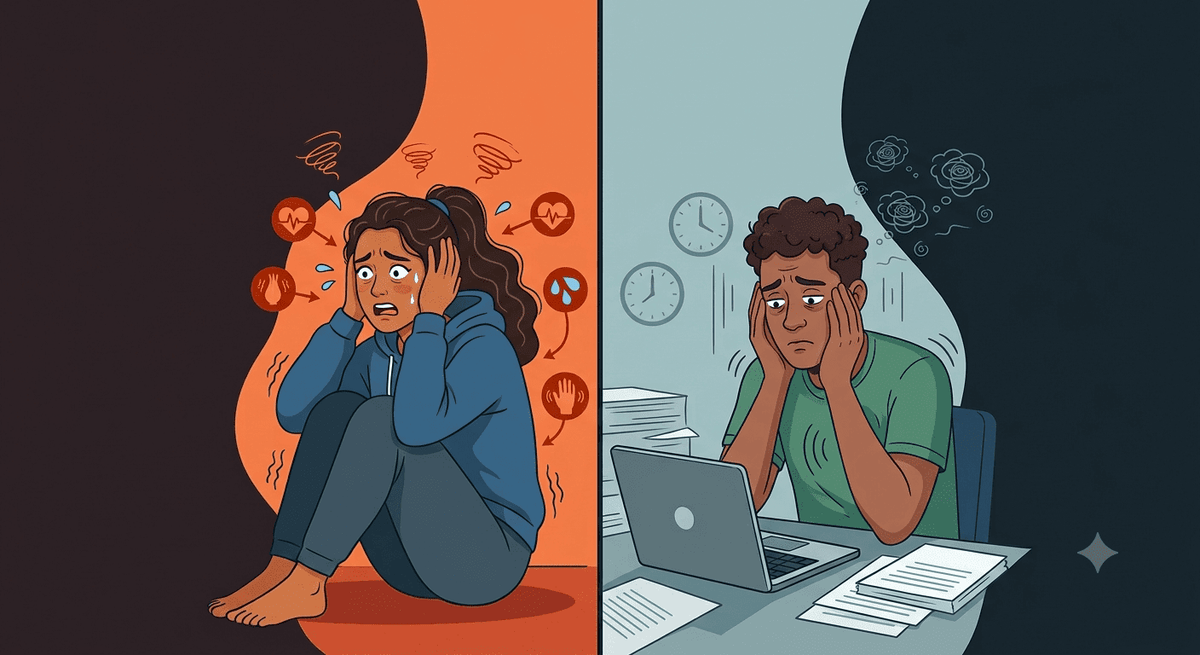
Your heart is pounding, your chest feels tight, and a wave of fear washes over you with no clear reason.
Is this a panic attack?
An anxiety attack?
Does it even matter what you call it?
It does, because the two experiences, while overlapping, have different patterns, different triggers, and sometimes need different management strategies.
This guide breaks down exactly how panic attacks and anxiety attacks differ, what is happening in your brain when either occurs, and how CBD helps manage panic and anxiety attacks in everyday life.
Are Panic Attacks and Anxiety Attacks the Same Thing?
No, though the terms are frequently used interchangeably in everyday conversation. Panic attack is a formally defined clinical term in the DSM-5, the diagnostic manual used by mental health professionals whereas anxiety attack is a colloquial term clinicians use to describe a more gradual build-up of anxiety symptoms in response to an identifiable stressor, rather than the sudden, discrete episode that defines a true panic attack.
What is a Panic Attack?
According to NCBI StatPearls, a panic attack is defined by the DSM-5 as an abrupt surge of intense fear or discomfort that reaches a peak within minutes, accompanied by at least four of a specific set of physical and cognitive symptoms.
Panic attacks can occur unexpectedly, with no obvious trigger, which is often what makes them so distressing. Recurrent, unexpected panic attacks, accompanied by persistent worry about future attacks, may indicate panic disorder, a diagnosable anxiety condition.
What is an Anxiety Attack?
An anxiety attack typically describes a build-up of worry, tension, and physical symptoms over minutes to hours, usually tied to an identifiable stressor such as a work deadline, a conflict, or an upcoming event.
Unlike panic attacks, which the NIMH describes as occurring 'out of the blue,' anxiety attacks tend to escalate gradually and are more clearly connected to ongoing worry or a specific source of stress.
Panic vs Anxiety Attack Symptoms
|
Feature |
Panic Attack |
Anxiety Attack |
|
Onset |
Sudden, abrupt, peaks within minutes |
Gradual, builds over minutes to hours |
|
Trigger |
Often unexpected, no clear cause |
Usually tied to an identifiable stressor |
|
Duration |
Typically resolves within 5 to 20 minutes |
Can persist for hours or longer |
|
Intensity |
Very high, often described as terrifying |
Moderate to high, more variable |
|
Physical symptoms |
Palpitations, chest pain, choking sensation, dizziness, trembling, sweating |
Muscle tension, restlessness, fatigue, mild palpitations |
|
Cognitive symptoms |
Fear of dying, fear of losing control, derealisation |
Persistent worry, racing thoughts, difficulty concentrating |
|
DSM-5 status |
Formally defined diagnostic term |
Not a formal DSM-5 term |
|
Associated condition |
Panic disorder (if recurrent and unexpected) |
Generalised anxiety disorder, social anxiety, specific phobias |
What Causes Panic Attacks and Anxiety Attacks?
Common Triggers for Panic Attacks
- Often occur with no identifiable trigger, described as coming 'out of the blue'
- Can be linked to a history of trauma, panic disorder, or other anxiety conditions
- Genetic and neurochemical factors play a role, including altered GABA and serotonin receptor activity in the amygdala, as identified in a systematic review on PMC (NCBI)
- Substance use, caffeine excess, and certain medical conditions including hyperthyroidism and cardiac arrhythmias can mimic or trigger panic attacks
Common Triggers for Anxiety Attacks
- Work or academic stress and looming deadlines
- Relationship conflict or social pressure
- Major life changes or uncertainty about the future
- Chronic, unresolved worry that builds cumulatively over time
- Sleep deprivation and physical exhaustion, which lower the threshold for anxiety symptoms
Is there a Link Between Panic Disorder and the Brain's Stress Response?
Yes, and the mechanism is well documented. A systematic review published in Translational Psychiatry (PMC) identifies corticotropin-releasing hormone (CRH) as a central neurochemical driver of panic disorder.
CRH, released in response to stress, modulates amygdala activity and triggers the hypothalamic-pituitary-adrenal (HPA) axis, leading to cortisol release. Dysregulation of this CRH-amygdala-HPA pathway is strongly implicated in both panic disorder and broader anxiety disorders.
A separate review on the neurobiology of panic published on PMC (NCBI) describes a fear network centred on the amygdala, which connects to the hippocampus, hypothalamus, and brainstem structures.
When this network becomes hyperactive, even non-threatening stimuli can trigger the cascade of physical symptoms associated with a panic attack: racing heart, rapid breathing, and a flood of fear signals, all without conscious deliberation.
This explains why panic attacks can feel like they have no trigger; the threat response is happening at a neurological level faster than conscious thought.
How Does CBD help with Panic Attacks and Anxiety?
CBD (cannabidiol) interacts with the body's endocannabinoid system (ECS) and several non-cannabinoid receptors involved in fear and anxiety regulation. It activates 5-HT1A serotonin receptors, the same receptor system targeted by several anti-anxiety medications, and inhibits FAAH, the enzyme that breaks down anandamide, raising the body's natural calming endocannabinoid tone.
The strongest human evidence comes from the simulated public speaking test (SPST), a standardised anxiety-induction paradigm. A landmark study published in Neuropsychopharmacology (PMC) found that a single dose of CBD significantly reduced anxiety in treatment-naive patients with social anxiety disorder during simulated public speaking, with effects comparable to standard anti-anxiety medications.
A review of CBD's anxiolytic evidence published on PMC (NCBI) confirms preclinical research has demonstrated panicolytic-like effects of CBD in animal models, alongside anxiolytic and anti-stress effects.
Evidence for CBD in anxiety disorders is encouraging but remains mixed. Clinical studies using the Simulated Public Speaking Test, including Cannabidiol Reduces the Anxiety Induced by Simulated Public Speaking in Treatment-Naïve Social Phobia Patients, have shown that CBD can significantly reduce anxiety in people with social anxiety disorder.
However, evidence for panic disorder is much more limited. A placebo-controlled study, Effects of Cannabidiol on Responses to a Carbon Dioxide Challenge in Healthy Volunteers, found that CBD did not reduce fear or panic responses during a CO₂-induced panic challenge, suggesting that its effects may differ depending on the type of anxiety, dose, and individual.
At present, CBD is best viewed as a complementary wellness tool rather than an established treatment for anxiety disorder or panic attacks.
What to Do During a Panic Attack: Step-by-Step
- Remind yourself this is a panic attack, not a medical emergency. It will pass, typically within 5 to 20 minutes.
- Inhale for a count of 4, hold for 4, exhale for 6. This activates the parasympathetic nervous system and counters hyperventilation.
- Use the 5-4-3-2-1 technique: name 5 things you see, 4 you can touch, 3 you hear, 2 you can smell, and 1 you can taste.
- Relax your shoulders, jaw, and hands deliberately. Physical tension reinforces the fear response.
- Resisting or panicking about the panic attack itself often intensifies and prolongs it. Let the wave pass through you.
- Seek a safe, quiet space: If possible, step away from overstimulating environments until the peak intensity subsides.
When to See a Doctor
Most panic and anxiety attacks resolve on their own, but certain patterns warrant professional evaluation:
- Recurrent, unexpected panic attacks accompanied by persistent worry about future episodes (possible panic disorder)
- Avoidance behaviour: skipping places, events, or activities out of fear of triggering an attack
- Anxiety or panic symptoms significantly interfering with work, relationships, or daily function
- Physical symptoms that could indicate a medical condition rather than panic (chest pain with cardiac risk factors, for example, should always be medically evaluated first)
- Anxiety symptoms accompanied by low mood, hopelessness, or thoughts of self-harm
Frequently Asked Questions
Is a panic attack dangerous?
A panic attack itself is not physically dangerous, even though it can feel life-threatening in the moment. The NIMH describes panic attacks as intense but self-limiting episodes. However, because panic attack symptoms can closely mimic serious conditions such as heart attacks, any new or unusual chest pain should always be medically evaluated first to rule out a cardiac cause.
Yes, in some cases. Anxiety that builds gradually and becomes intense enough can escalate into a full panic response, particularly in people prone to panic disorder. The distinction is not always clean in real life; the two exist on a spectrum, and an anxiety attack that intensifies rapidly can functionally resemble a panic attack. According to NIMH, most panic attacks peak within 10 minutes and resolve within 5 to 20 minutes, though lingering fatigue or unease can follow for longer. If symptoms persist well beyond this window or escalate further, it is worth seeking medical evaluation to rule out other causes. Clinical studies using the simulated public speaking test, including research published in Neuropsychopharmacology(PMC), have shown CBD can meaningfully reduce anxiety in social anxiety disorder. A clinical study published on PMC (NCBI) found that adding CBD before exposure therapy sessions helped people with panic disorder and agoraphobia experience greater reductions in fear and avoidance compared with exposure therapy alone. However, another controlled study found no effect on panic symptoms during a CO2-induced challenge, so CBD does not work identically for every panic-related presentation. It is best viewed as a potential complementary tool, not a guaranteed solution. There is no universal dosage. Clinical anxiety studies have used a wide range, generally within Ayush-licensed permissible limits for cbd products available in India. Always start with the lowest available strength and increase gradually under the guidance of a physician, who can tailor dosing to your specific symptoms, body weight, and any existing medication. Read more: How much CBD should you consume This requires medical supervision. CBD can interact with certain medications, including some SSRIs and benzodiazepines, by affecting liver enzymes involved in drug metabolism. Never start CBD alongside prescribed anxiety medication without first consulting your prescribing doctor or psychiatrist. Book a free Qurist doctor consultation for personalised guidance before combining CBD with any existing treatment. Can anxiety attacks become panic attacks?
How long does a panic attack last?
Can CBD really help with anxiety or panic attacks?
How much CBD should I take for anxiety?
Can I take CBD alongside my anxiety medication?



Leave a comment
All comments are moderated before being published.
This site is protected by hCaptcha and the hCaptcha Privacy Policy and Terms of Service apply.